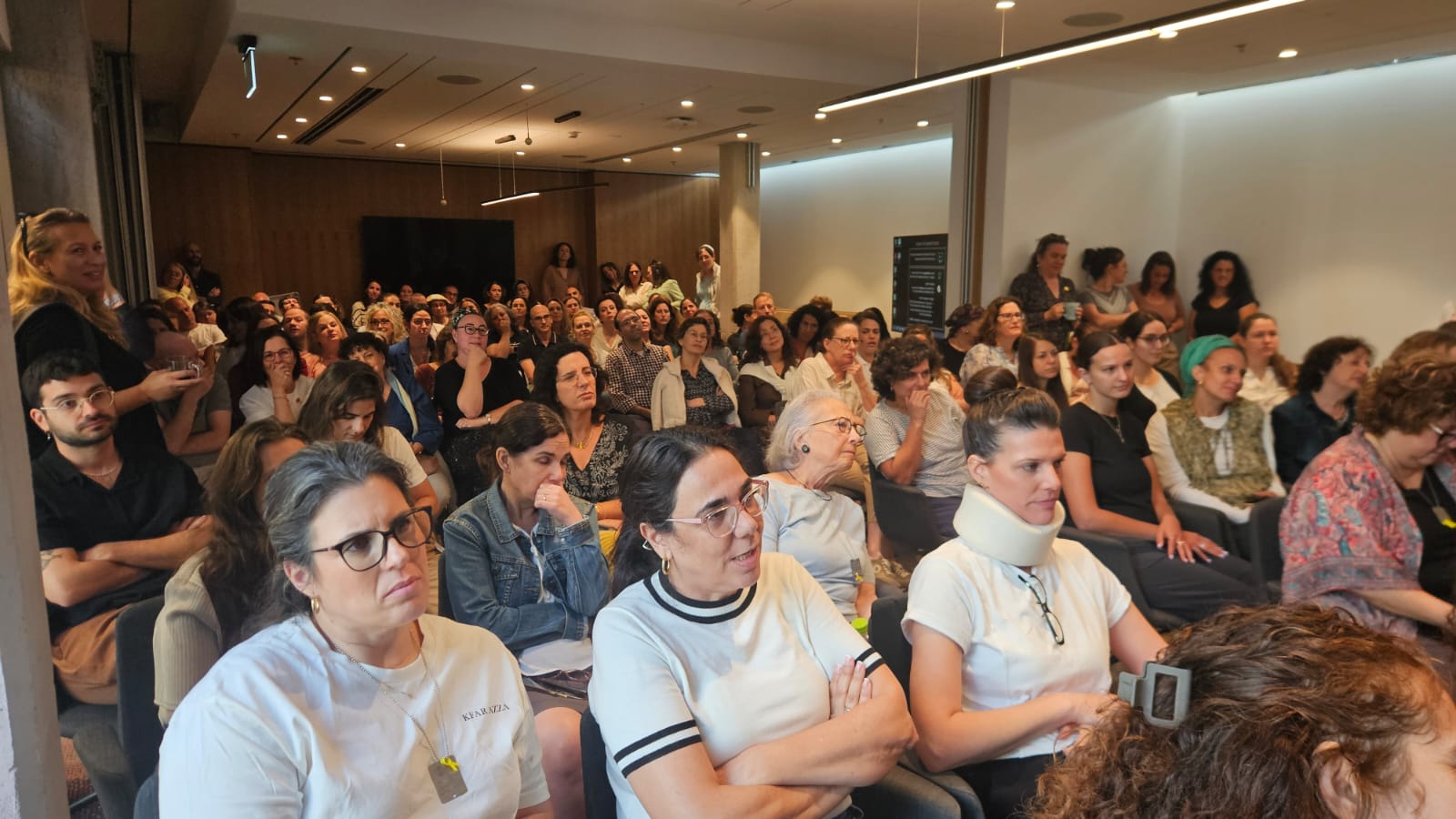
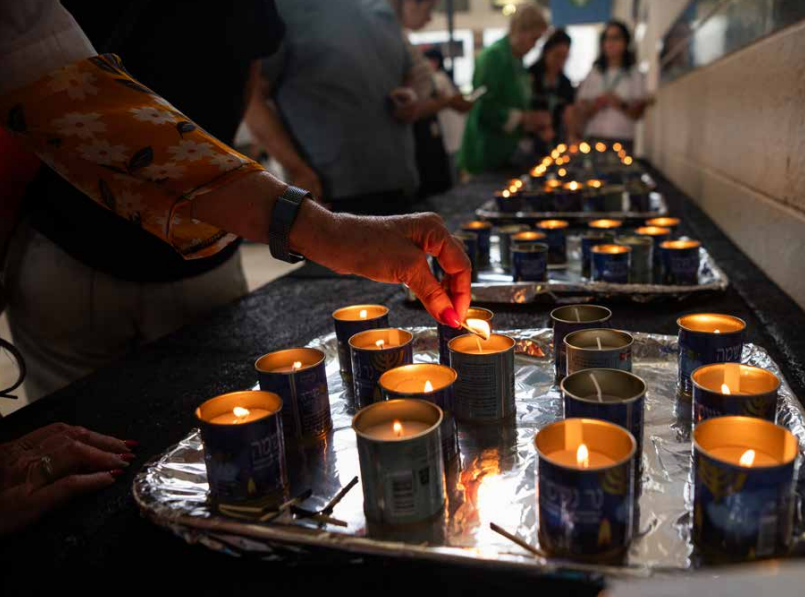
About Tears and Small Steps – The October 7 Gathering
My dear friend, the late Roi Levy, Yael’s partner, was gravely wounded—almost killed—during Operation Protective Edge in the battle of Shuja’iyya. After a long recovery that could only be described as miraculous, he returned to command the Egoz Unit, and on October 7 he fell in battle as commander of the Multi-Dimensional Unit, leaping without hesitation to save lives.
Roi was 44 years old when he was killed and left behind five children. On that day, Roi fought until his very last breath.
The memorial prayer I will now read was written by Yael Naveh, Roi’s wife:
May the people of Israel remember its sons and daughters who were kidnapped from their homes into the dark tunnels and the darkness of captivity.
May the people of Israel remember their families and friends whose souls shall find no rest and whose nights offer no peace, and the soldiers of the IDF who risk their lives to bring them home.
May the people of Israel remember its loyal and brave sons and daughters — residents of the Gaza Envelope, the security coordinators, members of the emergency squads, the children and adults, women and men — who were murdered, burned, raped, and shot by the cruel, for no fault of their own.
May the people of Israel remember them as they were — pure and good-hearted — at home and at the music festival, in the kibbutzim and in the cities, bound by fate in life and in death.
We shall remember, and we shall never forget.
That morning, at 6:29 a.m., when the end of the world descended upon us, horrors took place within us.
Who remembers what we were? How we lived? What we thought? What we loved—before the day words were torn from us, the day that changed us forever.
When the Holy One, blessed be He, remembers His children who suffer among the nations of the world, He sheds two tears into the great sea, and His voice resounds “from one end of the world to the other.”
(Talmud, Berakhot)
For two years we have been crying out a great cry, echoing from one end of the world to the other—and living the piercing silence.
Tears. So many tears have been shed over the past two years. Tears of every kind.
Tears of families receiving the most terrible of messages—or the almost as terrible—parents, children, spouses, brothers and sisters, grandparents, uncles and aunts, cousins, friends.
Guy Bezek was a fighter in Battalion 51. That morning, he was in battle near Kibbutz Kissufim. My friend Yuval, Guy’s father, wrote the following:
“The thought that this might be the last day of your life would not let go. I tried to stay optimistic. It’s not the first time you didn’t answer, the first time I worried. In the end, it always turned out my worries were for nothing.
I tried to distract myself, to believe that in the end it would be all right—that the call would come. Just a matter of time.
But the fear was already gnawing deep inside my head. Maybe it’s over. Maybe my Guy is gone.
Maybe I need to start getting used to the thought that this is your last day.
Two years have passed, and I still can’t get used to it. Everything feels like a distant, bad dream we’ll soon wake up from.
I remember our first hike on the Israel National Trail, when we reached the gates of Timna at sunrise and began climbing the cliff. A small boy with a backpack. I told you not to look up, and not to look back. Only one step forward. One step, and then another. Because heavy missions must be eaten in small bites. And in the end, you reach the summit and look back with satisfaction.”
On October 7, at exactly 11:00 a.m., I arrived at the IDF Personnel Directorate in Ramat Gan — the Casualty Unit. Reports poured in nonstop, and as the hours passed, I began to grasp the depth of the greatest rupture we have ever known — a bottomless pain.
We began to count, one by one — who was alive, who had been killed, who was missing — piecing together the picture for the State of Israel.
For many months we worked to identify the missing within Israel. The last to be identified was Bilha Yinon, who was murdered in Netiv HaAsara, identified on August 6, 2024.
The number stabilized at 255 hostages held by Israel’s enemies — and from there began the journey down to zero. To the very last hostage.
I love the IDF. I have given it all I could throughout most of my adult life. I felt, and still feel, part of the command echelon under whose watch the greatest military failure in the history of Zionism occurred. Day after day, for two years, I worked to ease the suffering of the hostages’ families and to ensure the most professional possible return of those who came home — carrying a debt so great we may never truly repay it.
Many tears were shed on December 15, when three hostages who had managed to escape — Yotam Haim, Alon Shamriz, and Samer Al-Talalka — were mistakenly shot and killed.
Many tears were shed on August 30, when six beautiful hostages were killed in the tunnel — Hersh, Eden, Ori, Alex, Almog, and Carmel.
And many tears were shed this week — with the reunification of families after 738 days.
Sometimes, there are no words.
No words to describe the whisper of a child returning from captivity, telling the psychologist preparing him for the reunion: “You’re wrong — my mother is dead.”
And then — the car stops, and his mother stands waiting, arms wide open, as he falls into her embrace. For more than fifty days he was held alone in captivity, believing he was the last survivor of his family.
No words to describe driving with three mothers on their way to retrieve their daughters — all speaking of birth stories before the birth of new life — and as we stop at the border line at sunrise, one mother says: “Do you realize this is the last sunset they saw from the Gaza side?”
No words to describe a hostage’s reaction upon hearing the devastating news that his loved ones are no longer alive.
No words to describe hostages recounting how they were held alone, utterly alone, for hundreds of days.
This week, I was privileged to complete the mission of returning the living hostages. The final helicopter took off toward the hospital, and I closed the gates of the return station at Re’im — this time, for good.
I was deeply moved, but not joyful.
There are still many families for whom the mission remains incomplete, and those who have returned face a long, complex journey of personal — and sometimes family — rehabilitation.
After the last helicopter took off, I drove for ten minutes to a roadside shelter near the community of Re’im — to ask forgiveness.
Forgiveness that we could not bring home more hostages alive.
At the entrance to that shelter stood, on October 7, Aner Shapira, the hero who fought the terrorists with hand grenades. Sixteen young people were murdered there; seven survived.
From that same shelter, four were taken hostage: Or Levy, Elia Cohen, Alon Ohiel, and Hersh Goldberg-Polin, who was murdered in captivity — a sweet boy I had known since he was seven, a child of light, love, and peace.
I entered the shelter and saluted for the last time these courageous young souls: to Aner, the hero who saved ten lives that day; to Hersh, who survived the horrors of captivity and was murdered alongside the six in the tunnel; and to Or, Alon, and Elia — whose families I was privileged to accompany at their reunion.
From the shelter of death, ten living souls emerged.
Heavy missions must be eaten in small bites.
Our mission is a heavy one. It cannot yet be said “was heavy,” though its weight keeps changing.
1,898 people were killed on October 7 — among them 915 IDF soldiers who have fallen since the beginning of the war, 468 during the longest ground maneuver in the history of the IDF inside the Gaza Strip.
20,000 people were physically wounded, and every day more and more wounds of the soul are revealed.
Hundreds of thousands were displaced from their homes and returned to a reality of immense challenge.
And we, too, here in this organization, are walking the path step by step — in small bites, small steps that extend a hand, a head, or a heart to those who need it.
In the hotels, in the return to the communities, with survivors of the festival, with the families of the hostages, with the bereaved families, with reservists, with those who suffered direct hits in body, soul, or property.
With those whose world has collapsed, with those who will never again be who they were, with those who fought, who defended, who struggled, who survived, who were saved.
“It was the best of times, it was the worst of times. It was the age of wisdom, it was the age of foolishness.
It was the epoch of belief, it was the epoch of incredulity.
It was the season of Light, it was the season of Darkness.
It was the spring of hope, it was the winter of despair.
We had everything before us, we had nothing before us.”
— Charles Dickens, A Tale of Two Cities
The mission is heavy, but I believe that now — when there are no more living hostages in Gaza, when we are within a ceasefire with the potential for an agreement — we will be able to take larger bites.
That we will take our tears and turn them into streams of life — of growth and renewal.
We will have good days here, because we have learned, in the hardest way possible, how precious life is.
Because so many of us have given everything one can give, and we are a society built on circles of giving.
Because many organizations will collaborate in rebuilding.
Because Israeli society desires to build.
Because our DNA is one of innovation.
Because vulnerability lives within us and dissolves arrogance.
Because Jewish and Israeli values are alive in the public sphere.
What a privilege it is to take part in hastening the work of rebuilding and repair.
“One step, and then another.
Because heavy missions must be eaten in small bites.
And in the end, you reach the summit and look back with satisfaction.”
We will have good days here.