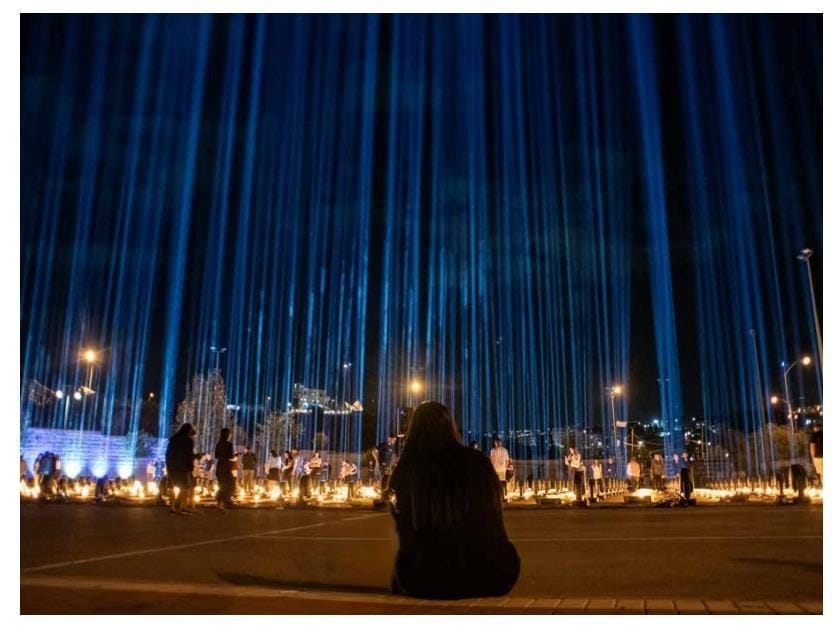
The complex reality has exacted — and continues to exact — a heavy toll on Israeli society. Vulnerable populations have become even more so, and many others have found themselves, for the first time, in need of support. From the fallen and the wounded to the abducted and the displaced — whether the connection is close or distant — that day and the events that followed it have transformed Israeli reality.
A harsh and multifaceted reality that cuts across all areas of life and demands new solutions. The waves of crises create far-reaching ripples and require enormous strength — from individuals and communities alike — in order to rise and move forward.
Thanks to those people we meet every day in our work since that fateful day, we are privileged to see light and hope. Through our partnerships with local authorities and organizations from across the diverse spectrum of Israeli society, all working together toward recovery and growth, we draw inspiration for the future of Israeli society.
The three stories presented here reflect the strength and resilience of remarkable people we met in the early days after October 7 — and who continue to move forward while choosing to see the good.
Zion Returned Home to Kiryat Shmona
Zion and Michal Saadia from Kiryat Shmona were evacuated to a hotel in Netanya on October 8. For a full year, they lived in a 25-square-meter room — one room — alongside tens of thousands of others who were evacuated from their homes across the country, not knowing when they would return.
They spent the recent Rosh Hashanah holiday at home, together with their family. Zion shares, with emotion:
“Home is home. Finally, the whole extended family together. During the evacuation, everyone was in a different place.”
The difficulty of being displaced — with great uncertainty, far from familiar surroundings, and without privacy — caused stress and hardship for many. Zion shared with us back then about his personal struggles:
“Every soldier who dies takes me back to 2006, to the Second Lebanon War, when my eldest son was killed,” says Zion, whose son, Liran Saadia the late, a fighter in the Egoz Reconnaissance Unit, fell in battle in southern Lebanon. “Every time the news talks about a fallen soldier, I reach extreme levels of tension and anxiety. That’s when I need the ‘quiet room.’”
What helped Zion cope during that time was The Quiet Room — our emergency program developed in cooperation with the National Occupational Therapy Headquarters at the Ministry of Health and operated by Beit Issie Shapiro. The rooms were deployed in hotels housing evacuees and provided a space of calm and serenity amid the chaos and uncertainty. These quiet rooms are a known method for reducing anxiety and emotional overload, and for supporting self-regulation — originally designed for individuals with neurological diversity such as autism or other neurological conditions, and used in mental health centers. The decision to bring them into evacuation hotels helped many people — with and without disabilities — who overnight lost stability and independence in their lives.
This past March, the Saadia couple returned home to Kiryat Shmona — to a house that had been hit directly by a rocket while they were away. They had, of course, arranged for repairs remotely before their return. Today, Zion has resumed his work as a physical education teacher at a local school.
Their return home marks a cautious recovery. Thanks to his inner resilience, Zion speaks of returning to routine — but in the same breath acknowledges that life in Kiryat Shmona is far from normal:
“We went through a tough period. We’re back to routine, but not completely.”
For him, there was never any question of not returning:
“My son is buried in Kiryat Shmona. There’s no way I’d leave him there and move to the center of the country.”
In closing, Zion radiates cautious optimism and recalls the quiet room that served as an anchor in difficult times:
“I used to go there, disconnect completely… and it did me good.”
Watch Zion’s story and the Quiet Room:
The Municipal Security Officer Who Also Volunteers for Community Safety
The southern city has endured the highest number of rocket attacks from Gaza since October 7. Adir Shai, the city’s municipal security officer, found himself at the heart of the storm — juggling dozens of simultaneous rocket strike incidents, dispatching teams to trauma sites, and ensuring the safety of both residents and municipal employees.
Today, in addition to his crucial role, he also leads — as a citizen and a volunteer — community-based security initiatives. Through his personal story, he exemplifies both systemic and personal transformation.
On one of the city’s most intense days, when a rocket hit directly, Adir and his team rushed to multiple impact sites. When one of his staff members returned from a particularly horrific scene — having evacuated a person injured in a direct hit — Adir immediately recognized the signs of trauma.
“He came back to city hall with his clothes soaked in blood. He wasn’t even aware of his condition; he couldn’t form a full sentence.”
Not long before that, Adir had taken part in Or Rishon (“First Light”) — a training program by JDC and the Academic College of Tel Aviv–Yaffo, designed to help local authority officials identify early signs of psychological distress.
“The training taught me not only to recognize distress, but also how to act at the critical moment,” Adir shares. “I realized that mental resilience and the ability to identify who needs help are just as important as the operational response.”
To date, hundreds of municipal employees — including a wide range of public service professionals who meet residents daily — have completed this training.
Watch Adir’s story:
Today, the rocket threat to Ashkelon has subsided, but nerves remain frayed.
“You walk out of the supermarket with your kids, hear a motorcycle passing, and your heart starts pounding,” says Adir. “But then you see a patrol car, and the color comes back to your face.”
The patrol car he refers to belongs to the Neighborhood Watch — a civilian volunteer corps that patrols the city as an additional force supporting official security services and helping to restore residents’ sense of safety.
“At this point, there are almost two patrol cars out every evening — just their presence is reassuring,” adds Adir.
Both Neighborhood Watch and Or Rishon are programs introduced to the city as part of our Mishiv HaRuach (“Restoring the Spirit”) initiative. Or Rishon was developed as part of an emergency-response toolkit, and Neighborhood Watch grew from field needs identified through Mishiv HaRuach. Through this work, we understood that some municipalities needed long-term intervention, leading to a model in which a dedicated project manager works alongside the municipality to promote initiatives in mental health, education, community, and employment — all aimed at restoring residents’ sense of security and control over their lives.
In addition to his demanding job, Adir also volunteers in the Neighborhood Watch:
“I’m in charge of the Afridar area, in the north of the city. We have 80 volunteers and over 8,000 volunteer hours. That includes patrols, emergency response units, and more. At certain times, we’ve managed to double the number of security forces in the city — it’s incredible, and it really gives residents a sense of safety.”
In his view, two years later, the tension remains — everyone still feels the impact of wartime reality and yearns for the return of the hostages. But the very fact that residents take part in their own security brings meaning and resilience:
“Mishiv HaRuach — this project — it’s by the community and for the community. Instead of complaining about insecurity, people choose to be the solution. As a municipal representative, I’m proud to be part of it. And as a resident of Ashkelon, being part of the story of the Jewish people gives me the feeling that I’m part of a great fire that will never go out.”
Lilach from Ofakim — Who Once Struggled to Leave Home, Now a Rehabilitation Instructor
Lilach lives in the Mishor HaGefen neighborhood of Ofakim, where 52 residents were murdered on that Black Saturday. “We woke up to the sound of sirens,” recalls Lilach. But due to the horrors unfolding right outside her living room, she and her family were trapped inside their home for hours — with baby twins under one year old.
Lilach and her family — with five children in total — were evacuated after long hours of terror, with death and destruction just meters away.
After two and a half months in a hotel, they decided to return home. But the sights and smells of that day — October 7 — remained deeply engraved in her memory, making it hard for her to function or even step outside, especially at night.
That changed when Lilach began taking part in activities at the new community center in her neighborhood — HaBayit BeMishor (“The House in Mishor”) — established by JDC, the Municipality of Ofakim, the MetroWest Federation, and Natan NGO as part of the Mishiv HaRuach initiative in the city.
The center is operated by neighborhood women volunteers who organize and lead diverse activities for residents of all ages — all aimed at strengthening personal and community resilience.
Today, Lilach openly shares that family life has not yet returned to what it was, and that they are still in a process of recovery. But she emphasizes that had she not taken part in the activities in those early days after returning home, she doesn’t know where she’d be today:
“If I hadn’t gone out to those activities — if I had shut myself in — I would’ve gone back years. The volunteers working with us did amazing work.”
Though her family now participates less in ongoing activities, Lilach keeps in touch with the center and plans to register her youngest for an upcoming parent–child soccer program. She explains why, with a note of encouragement:
“I used to talk about my fears and difficulties. Now I’m helping others. I work as a rehabilitation instructor for people coping with mental health challenges — some of them survivors of October 7. I even work evenings now — we’re all pretty busy.”
She describes how, through these experiences, she has gotten to know her neighbors — something that hadn’t existed before:
“Today, I know everyone. There’s a real sense of community — and that’s not something to take for granted,” Lilach says, summing up what this means to her as someone who, in her words, could have fallen apart along the way:
“You were here in the critical moment — and you stayed. That’s what makes the difference: understanding that the waves keep coming long after the first one. The impact of it all is immense. You truly see us.”
Remembering, Waiting, and Choosing to Act
The people along the way — those we’ve met through our programs, our partners, and JDC’s own staff — all experienced the events of this period in their own ways, each carrying a personal story of resilience and steadfastness.
From these experiences comes our choice: to dedicate resources, knowledge, and expertise to help Israeli society — its people and communities — strengthen their resilience and face an ever-changing reality.
Thanks to them, we choose to see the light, draw strength from the field, and continue working together toward recovery, renewal, and growth.
We continue to pray for the safe return of all hostages and soldiers — and for quiet days ahead.